

Predictive Maintenance of Hoses: 5 Strategies for Business Continuity
In the budget of an industrial plant, the cost of a flexible hose is often...
In the budget of an industrial plant, the cost of a flexible hose is often...

In modern industrial automation, pneumatics is not just about movement, but about...

In the world of industrial seals, there is a boundary between a component that “closes” a...
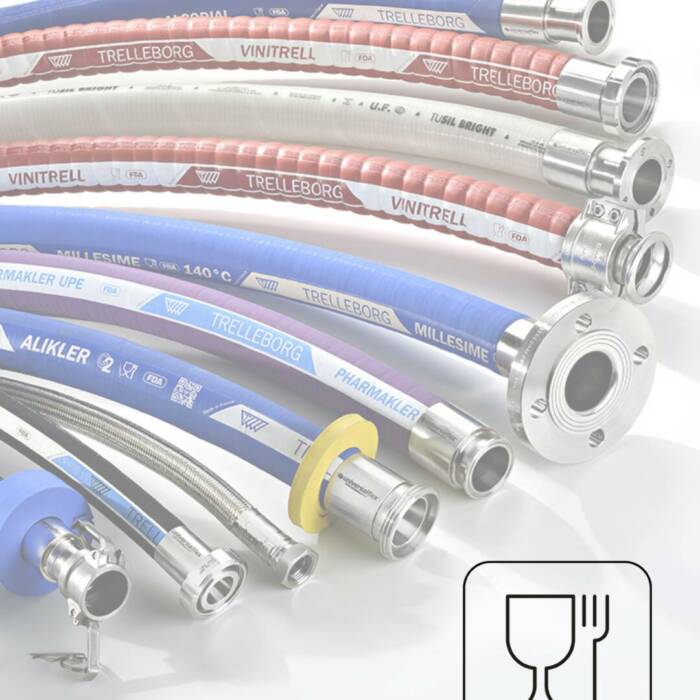
In the Food and Cosmetics industries, compliance with regulations regarding Materials and...
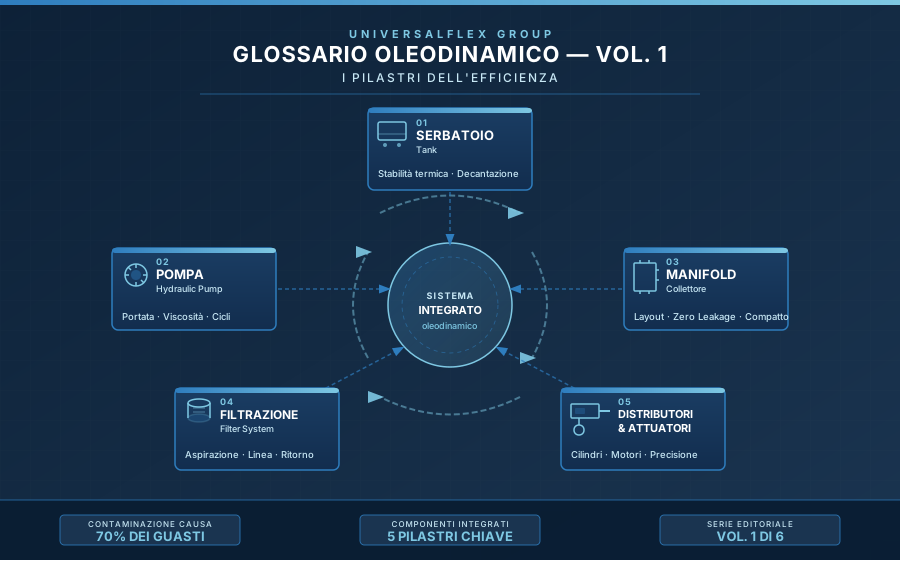
At Universalflex Group, we believe that technological excellence must always go hand in hand with training. Supporting the...
When we talk about Food & Beverage industry, food safety is at the top of the list of priorities. To work safely it is necessary to use materials that do not contaminate food.
Pipes intended for the food industry come into contact with food products and semi-finished products, for this reason the pipe materials must not contain substances that can migrate into the food.
The material the tube is made of can release harmful components into the food during use. This can lead to:
To avoid this, food grade hoses must comply with Regulation (EC) 1935/2004. This is the European regulation that regulates materials and objects, including plastic, rubber and silicone, intended to come into contact with food.
Before using the tube, we ALWAYS recommend washing or sanitizing it, following the manufacturer's instructions or contacting our technicians.
In food applications, the hoses used are generally made of rubber, silicone, PVC, PTFE, polyurethane, etc. However, not all materials are suitable for contact with all types of food.
Rubber hoses have a higher temperature range than PVC or Polyurethane hoses. They can withstand an operating temperature from -30°C to 150°C depending on the hose chosen. Particularly suitable for the passage of all liquid and powdered foods.
Silicone tubing is particularly flexible and can withstand high temperatures compared to other materials. It is USP Class VI certified and suitable for use in the cosmetic and pharmaceutical industries.
PVC pipes are suitable for many applications where operating pressure and temperature are limited, such as drinking water, soft drinks and various raw materials. Most PVC pipes have a temperature range of -20 ° C to + 60 ° C. An advantage of PVC pipes is that they are transparent, lightweight and generally very flexible. However, because its strength is limited, PVC is not suitable for use with fatty foods.
PTFE tubing is ideal for high temperature and pressure applications. It has a temperature range of approximately -70°C to +260°C, has excellent chemical resistance and is easy to clean.
Hoses used for transporting dry and abrasive foods are often made of polyurethane. Polyurethane is resistant to fatty foods and has a temperature range of -40 ° C to + 90 ° C. These hoses are also ideal for powdered milk, spices and other dry ingredients.
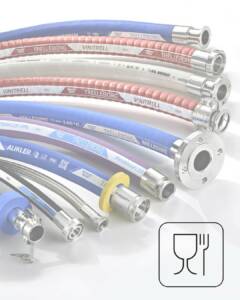
Our FDA and MOCA certified flexible hose assemblies ensure perfect hygiene and are suitable for all industrial processes related to the food, pharmaceutical and chemical sectors.
The connection system adopted by Universalflex prevents, thanks to the use of connections with a special designed profile, the stagnation of the product and consequently the proliferation of bacteria. The elastomers (phthalate-free) and the characteristics used in the pipe mixes respond, in fact, to the most severe standards in terms of food safety.
In the budget of an industrial plant, the cost of a flexible hose is often...
In modern industrial automation, pneumatics is not just about movement, but about...
In the world of industrial seals, there is a boundary between a component that “closes” a...
In the Food and Cosmetics industries, compliance with regulations regarding Materials and...
At Universalflex Group, we believe that technological excellence must always go hand in hand with training. Supporting the...
Adding {{itemName}} to cart
Added {{itemName}} to cart