

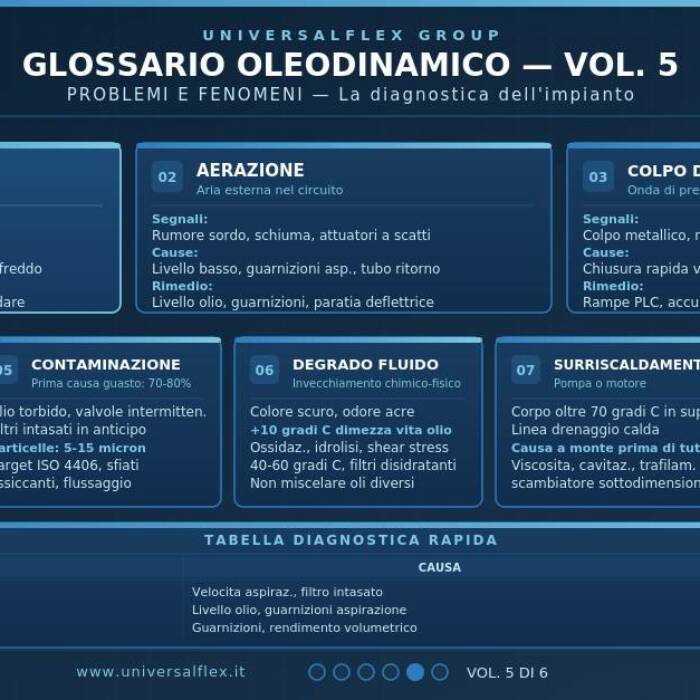
Hydraulic Glossary Vol. 5: Problems and Phenomena – System Diagnostics
In previous volumes of our Hydraulic Glossary, we built a system piece by piece:...
In previous volumes of our Hydraulic Glossary, we built a system piece by piece:...
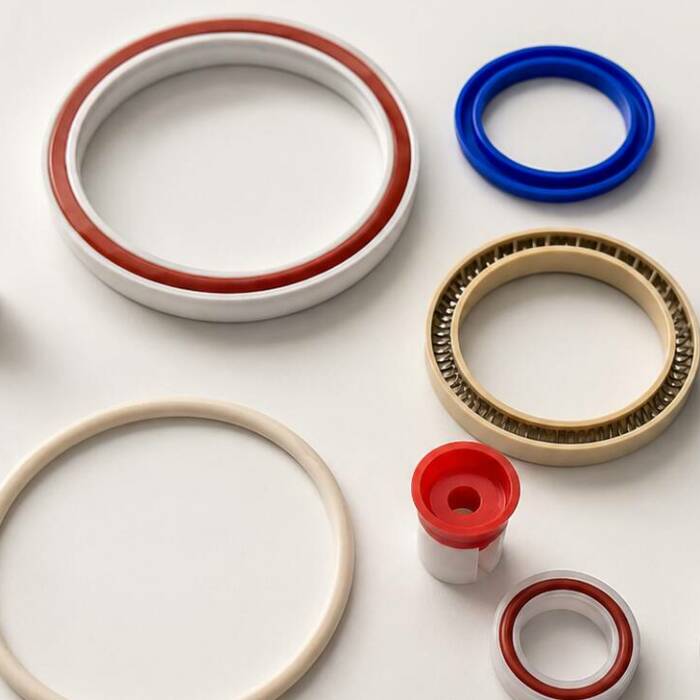
A gasket with a standard profile works in most industrial applications. However, there are...
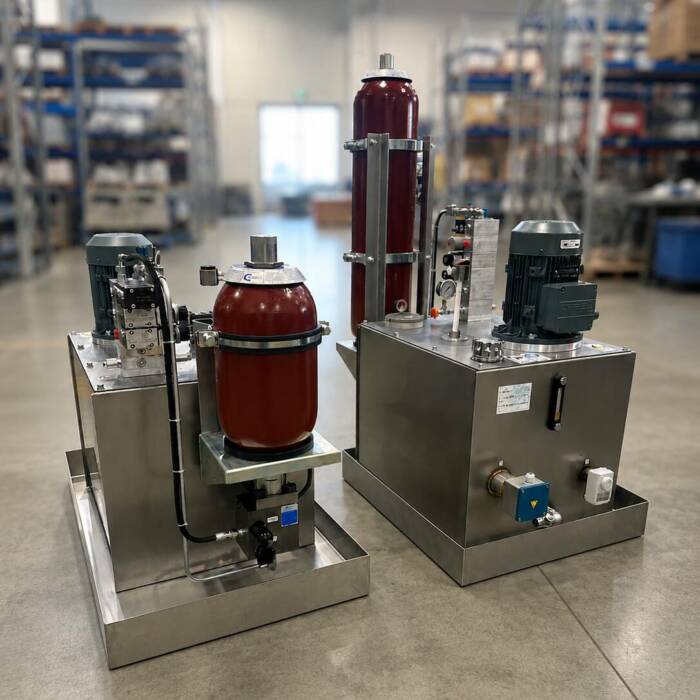
A standard hydraulic system covers most industrial applications at a low cost...
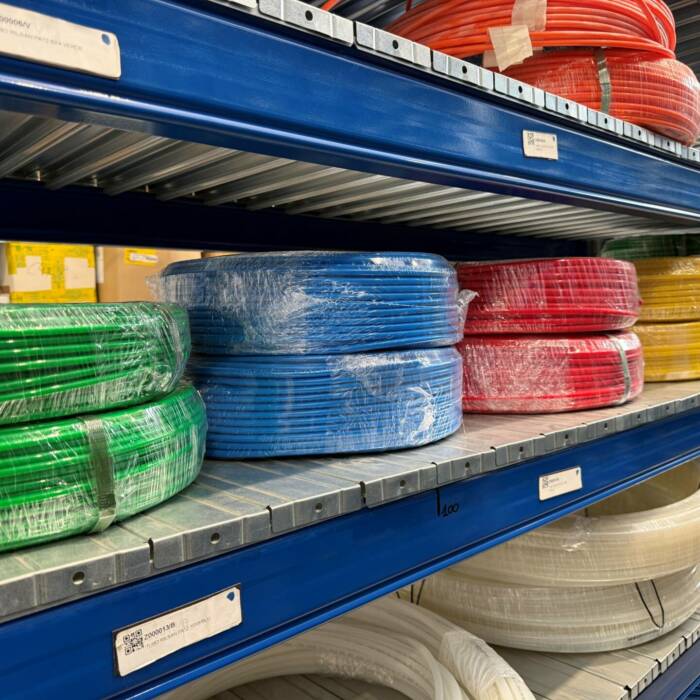
In the industrial sector, choosing a plastic hose is never...

In previous volumes, we analyzed components, valves, and technical parameters. In this fourth chapter...
In our guide to choosing the right material for industrial gaskets We presented HPU as the reference material when the main problem to be solved is intense abrasion, extreme dynamics and resistance to high sliding speeds.
With this materials section, we begin a series of dedicated in-depth analyses. The first is HPU, the material furthest removed from traditional elastomers, yet the one that offers the most significant advantages when used in the right context.
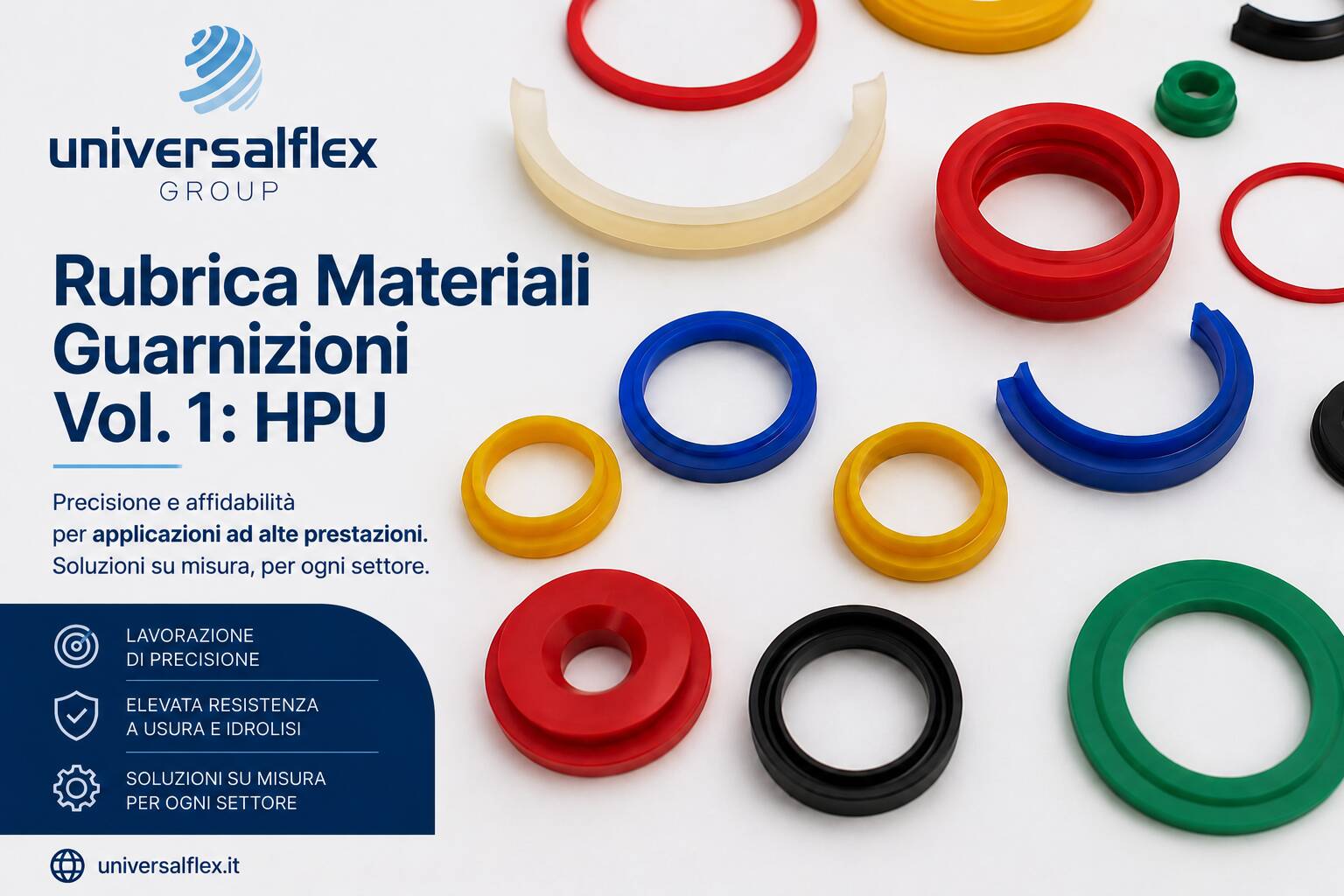
The HPU (Hydrolysis-resistant Polyurethane, or polyurethane hydrolytic) is a polyurethane elastomer in the TPU family (Thermoplastic Polyurethane), or thermoplastic polyurethane elastomers. This clarification is important for understanding how the material behaves under load and how it is processed.
Conventional elastomers such as NBR, FKM, and EPDM are thermosetting materials: once vulcanized, they do not change state. HPU, being a thermoplastic, can be melted, molded, and solidifies again upon cooling. This makes it machinable by turning, a feature that allows for customized and precise sealing profiles with tolerances unattainable with traditional elastomers.
Chemically, HPU is obtained from the reaction between a long-chain polyol and a diisocyanate, with the addition of a chain extender. The ratio between rigid (hard) segments and flexible segments determines the final mechanical properties: hardness, elasticity, and abrasion resistance. Polyether-based formulations (those of HPU) hydrolytic) ensure better low-temperature properties and hydrolysis stability, distinguishing them from standard polyurethanes.
This is where HPU is unrivaled. Its abrasion and cut resistance is significantly superior to any conventional elastomer, with wear values 5-10 times lower than natural rubber. Added to this are:
The HPU is designed for the most severe hydraulic systems.
Here's how it behaves at different pressure levels:
| Pressure regime | HPU Behavior | Operational notes |
| Low pressure (< 160 bar) | Work in complete safety | Perfect seal even at values close to zero |
| High pressure (160-400 bar) | Ideal field of HPU | Shore A hardness 95 prevents extrusion |
| Very high pressure (> 400 bar or peaks) | Excellent with support | Add anti-extrusion ring in POM or PTFE |
The standard operating range of HPU is -30 degrees C to +110 degrees C, with special compounds extending the range to -50 degrees C and +130 degrees C. This is superior to standard NBR and suitable for the vast majority of hydraulic and industrial applications.
One aspect that deserves specific attention is its behavior in the presence of water at high temperatures. Here, HPU stands out significantly from standard polyurethanes:
Standard polyurethanes – particularly polyester-based ones – undergo hydrolysis when exposed to water: water penetrates the molecular chains and breaks them, leading to a rapid loss of mechanical properties until the component disintegrates.
HPU counteracts this phenomenon thanks to a special polyether-based formulation with specific anti-hydrolysis additives that prevent water molecules from attacking the polymer bonds. The result:
HPU offers good resistance to mineral oils, hydrocarbons, and greases, as well as fire-resistant HFA and HFB hydraulic fluids and biodegradable hydraulic fluids (vegetable oils and synthetic esters). Chemical compatibility is the most important consideration during the selection process.
Here are some of the main cases:
| Fluid / Agent | HPU Compatibility | Note |
| Mineral hydraulic oils (ISO VG 32-68) | Excellent | Environment of choice for HPU |
| HFA and HFB fluids (water-based) | Good (up to 60 degrees C) | Check with supplier for T > 60 degrees C |
| HETG fluids (vegetable oils) | Good | Check long-term compatibility |
| HEES fluids (synthetic esters) | Good | Beware of high concentrations > 60 degrees C |
| Aliphatic hydrocarbons | Good | Gasoline, kerosene |
| Cold water (< 40 degrees C) | Good | / |
| Hot water (up to +90 degrees C) | Good (hydrolytically stable HPU) | Not valid for standard PUR |
| Water > 90 degrees C / steam | Not recommended | Beyond the limits of HPU: prefer EPDM or FKM |
| Strong polar solvents (acetone, MEK) | Incompatible | Accelerated degradation |
| Ozone / prolonged UV rays | poor | Progressive surface aging |
Important: Some HPU formulations are certified for food contact according to EU Regulation 1935/2004, EU 10/2011, 3A Sanitary standards, and FDA directives. This also opens HPU to sectors such as food processing and pharmaceuticals – although silicone and PTFE remain the preferred materials for most static food applications.
As we emphasized in the general guide, the type of motorcycle is one of the key factors to consider when choosing the right material. This is particularly important for the HPU.
This is the context of HPU excellence. Its extremely low dynamic friction and extraordinary resistance to sliding abrasion make it the highest-performing material for rod and piston seals in linear motion applications. HPU withstands linear speeds up to 0,5 m/s while maintaining dimensional integrity and preload over time.
The stresses typical of this context (e.g. high-frequency cycles, potentially particulate-contaminated oil, pressure fluctuations) are those for which HPU offers the greatest competitive advantage over NBR.
The HPU also works very well as a static seal, provided that the load limits that would cause long-term compression set are not exceeded. The low permanent deformation of the material ensures that the preload is maintained.
Polyurethane is susceptible to heat buildup from friction in applications involving continuous, high-speed rotation. If the shaft rotates at high speeds, the material risks overheating and degrading. In these cases, PTFE or FKM (Viton) are preferable. HPU, however, remains adequate for low-frequency oscillating motions.
Hydraulics is the preferred sector for HPUs. Linear hydraulic cylinders, piston pumps, distributors, actuators, and linear guides find HPU seals the most effective solution to the need for dynamic sealing at high pressures and with long life.
Excavators, mechanical shovels, cranes, compactors: the actuation cylinders of these machines operate in environments with intense dirt, vibrations, temperature fluctuations, and frequently contaminated oil. HPU is the material that best tolerates these conditions. Furthermore, its resistance to hydrolysis makes it suitable for machinery constantly exposed to rain, mud, and high-pressure washdowns—conditions that rapidly degrade standard polyurethanes.
In EU 1935/2004 and FDA-certified formulations, HPU is suitable for machinery used in the processing, bottling, transportation, and packaging of food and pharmaceutical products. A specific advantage in this sector is its resistance to CIP (Clean-in-Place) cycles: HPU withstands aggressive cleaning with hot water and chemical detergents without swelling or loss of hardness, a critical limitation of silicone and many standard elastomers in intensive sanitization environments.
Hydraulic presses for metalworking and stamping operate at high pressures and in close cycles. HPU's ability to maintain its mechanical properties after a high number of cycles, without failure due to elastic fatigue, makes it the preferred material for main piston sealing systems.
Rolling mills use hydraulic cylinders in environments with rolling emulsions and microscopic metal flakes. HPU, thanks to its resistance to tearing and abrasion from hard particles, maintains a seal in conditions that would quickly compromise gaskets made of softer materials.
Hydrolysis stability and resistance to seawater make HPU suitable for hydraulic systems on agricultural machinery, port equipment, and any system exposed to continuous atmospheric humidity. It is one of the few gasket materials that does not suffer degradation from storage in tropical or very humid warehouses.
As we saw in the general guide to materials, every choice begins with an analysis of the main problem to be solved. HPU excels in a specific area, and other contexts where another material is preferable.
| Scenario / Main problem | Correct choice | Motivation |
| Intense abrasion + dynamism + mineral oils | HPU | Ideal condition: no elastomer competes |
| High pressure (160-400 bar) with reciprocating motion | HPU | Extrusion resistance + cycle life |
| Humid environment, outdoor, water up to 90 degrees C | HPU (hydrolytically stable) | Higher hydrolysis resistance than standard PUR |
| High temperature > 150 degrees C + aggressive chemicals | FK extension | HPU exceeds thermal limit |
| Steam, water > 90 degrees C | EPDM | HPU not suitable beyond hydrolytic limits |
| Universal chemical resistance, static application | PTFE | HPU does not withstand strong polar solvents |
| Mineral oils, low cost, moderate pressures | NBR | HPU does not justify the additional cost |
| Food / pharmaceutical (static application) | Silicone or PTFE | Preferred for ease of certification |
| Continuous rotation at high speed | PTFE or FKM | HPU suffers heat buildup from friction |
Identifying signs of wear or material incompatibility is the first step to intervening before a failure occurs. For HPUs, the signs are clearly distinguished by their cause:
If any of these phenomena occur before the expected end of life, the problem isn't the gasket itself, but the operating conditions. The Universalflex technical team is available to analyze the situation and propose the most suitable solution.
The choice of material is never disconnected from other design parameters. This is particularly true for the HPU:
At Universalflex we always support customers even in the selection phase, integrating knowledge of materials with design experience in specific industrial applications.
Q: What's the difference between HPU and standard PUR? Can I use any polyurethane for my hydraulic seals?
A: No. HPU is a specific formulation of polyether-based thermoplastic polyurethane (TPU) designed for hydraulic sealing: its hardness, resistance to extrusion pressure, hydrolysis stability, and compatibility with mineral oils are optimized for this purpose. Standard polyurethanes, often polyester-based, degrade rapidly in contact with hot water and cannot withstand the conditions of hydraulic systems. When specifying seals for hydraulic cylinders, it is always necessary to explicitly specify HPU or a grade certified for hydraulic use.
Q: Can I replace an NBR gasket with an HPU one of the same size?
A: In most cases, yes, but with a preliminary check of the seat tolerances. HPU has a lower compressibility than NBR: if the seat was sized with wide tolerances for NBR, it may not guarantee the correct preload for the HPU. Before replacement, it is always advisable to check the seat dimensions with the supplier or a trusted technical partner.
Q: Is the HPU resistant to hot water?
A: The answer depends on the type of HPU. Standard polyester-based polyurethanes degrade rapidly in water above 40-50°C. Hydrolytically stable HPU (polyether-based with anti-hydrolysis additives) guarantees continuous stability up to +90°C in hot water and good performance even in salt water and HFA/HFB fluids. This is the version used by Universalflex for seals in hydraulic and outdoor applications.
Q: Is the HPU suitable for HEES and HETG biodegradable hydraulic fluids?
A: Generally, yes, with appropriate testing. HPU offers good compatibility with vegetable oils (HETG) and synthetic esters (HEES) under standard operating conditions. However, for temperatures above 60°C with HEES fluids, a specific compatibility check with the supplier is required, as some formulations may exhibit swelling over time.
Q: What are the signs that my HPU gasket is made of the wrong material?
A: The most common signs of material incompatibility are swelling when in contact with the fluid, loss of hardness and abnormal softening, surface cracking and hardening, and accelerated edge wear. If any of these phenomena occur before the expected end of life, the problem is likely in the operating conditions, not the seal itself.
Q: Is the HPU food grade certified?
A: Some HPU formulations are certified for food contact pursuant to EU Regulation 1935/2004, EU Regulation 10/2011, 3A Sanitary standards, and FDA directives. Certification depends on the specific compound used, not the material in general: it is always necessary to request documentation of compliance for each food application. For static applications in the food sector, silicone and PTFE remain the reference materials. Certified HPU is particularly useful where aggressive CIP cycles or mechanical resistance superior to that of silicone are required.
Q: How long does an HPU gasket last compared to an NBR one?
A: Under optimal operating conditions, an HPU seal can last 3 to 10 times longer than an equivalent NBR seal. This advantage is further enhanced in environments with contaminated oil or high-frequency cycling, which are the most critical conditions for NBR. In particularly demanding environments such as earthmoving or rolling mills, the difference in life can be even more significant.
Do you need technical support in choosing gaskets?
Universalflex supports its customers in the selection and supply of seals for hydraulic and industrial applications. Need to evaluate whether HPU is the right material for your application or identify the most suitable alternative? Our technical team is available.

We inform our customers and partners that Universalflex offices will be closed for...
In previous volumes of our Hydraulic Glossary, we built a system piece by piece:...
A gasket with a standard profile works in most industrial applications. However, there are...
A standard hydraulic system covers most industrial applications at a low cost...
In the industrial sector, choosing a plastic hose is never...
Adding {{itemName}} to cart
Added {{itemName}} to cart


