

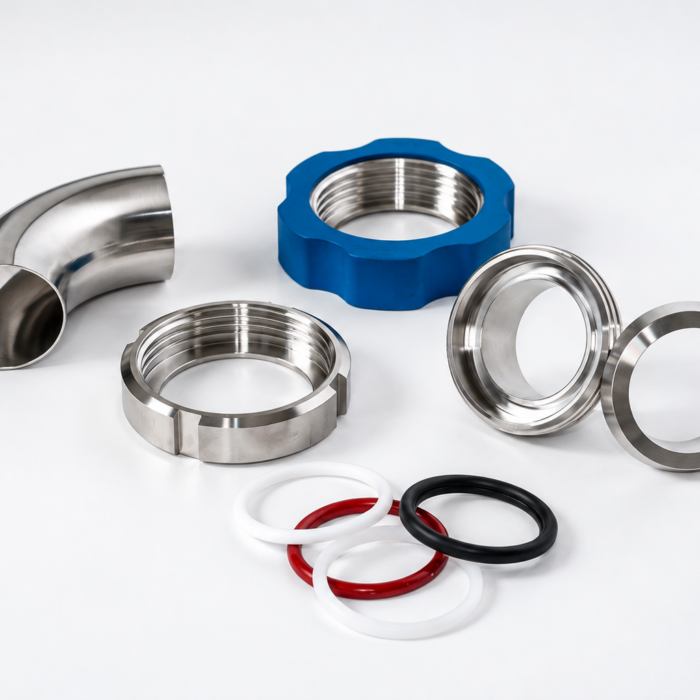
DIN 11851 in the food industry: fittings, gaskets and areas of application
Anyone who works in a dairy, winery, or beverage plant...
Anyone who works in a dairy, winery, or beverage plant...
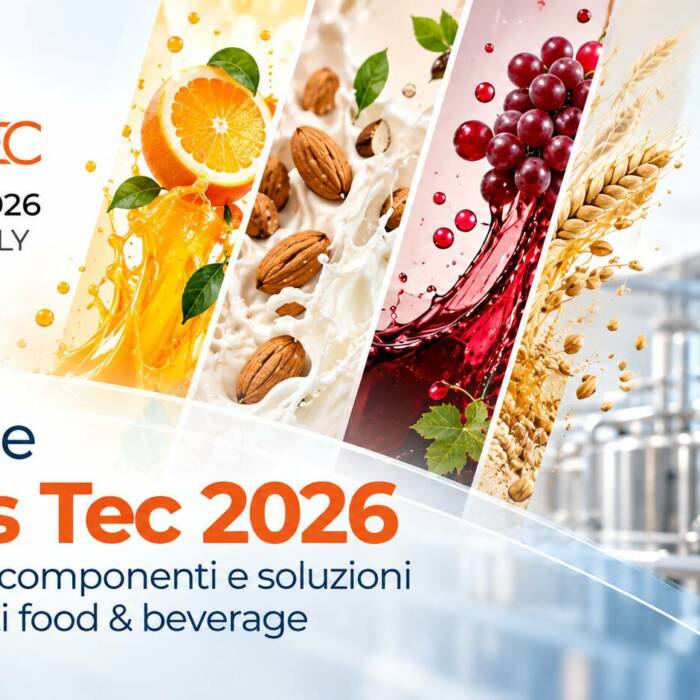
From October 27 to 30, 2026, Fiere di Parma will host Cibus Tec, the...
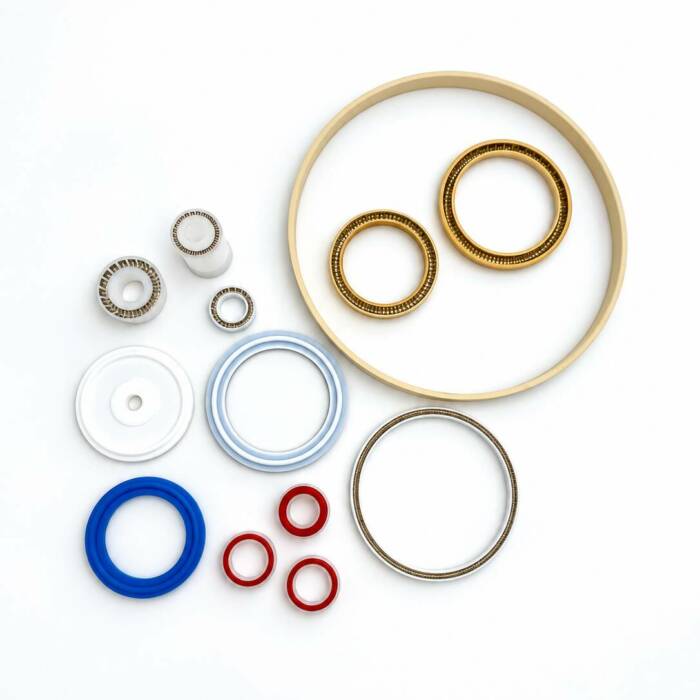
PTFE (polytetrafluoroethylene) is the leading fluoropolymer for industrial seals...
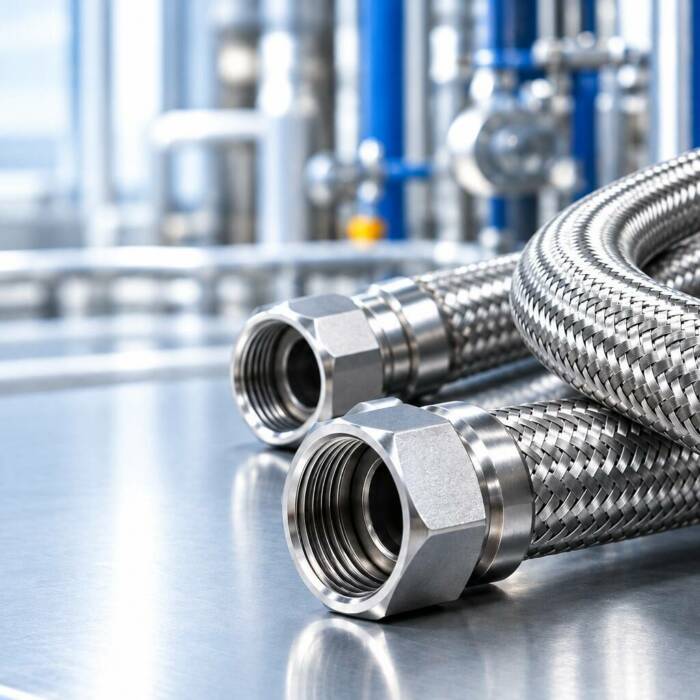
When a system must convey steam, technical gases, cryogenic fluids, or aggressive chemicals,...
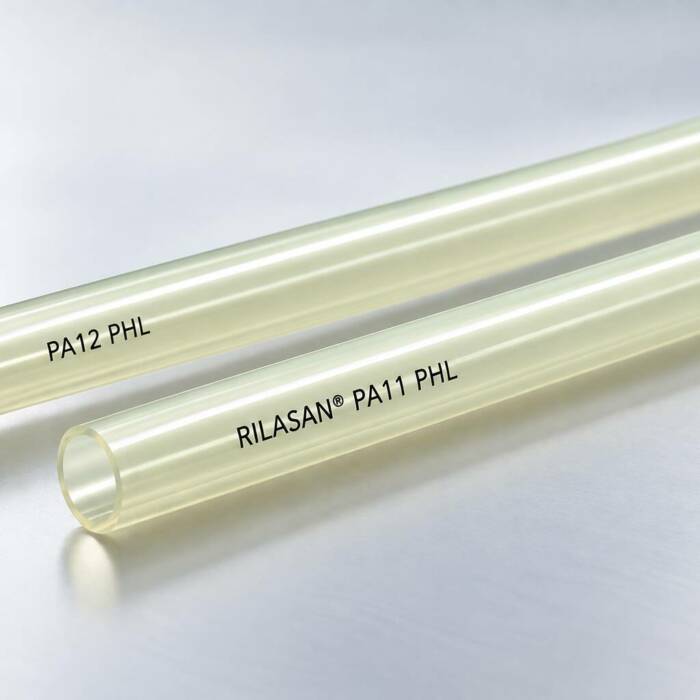
When designing a pneumatic circuit or replacing a pipe...
Between July and September, tomato processing plants operate at full capacity. The canning season is one of the most intense production cycles in the Italian food industry: concentrates, purees, peeled tomatoes, and tomato derivatives must be processed and packaged quickly, following strict and precise production processes.
In this context, production hygiene is essential. Tomato paste, like many other products, follows an aseptic process : the product is sterilized at high temperatures, cooled, and then transferred and packaged under conditions that prevent any microbial contamination.
If a pipe leaks, a gasket deteriorates, or a fitting no longer ensures a tight seal, aseptic conditions are compromised. This risks contaminating the entire line, resulting in plant downtime and product recalls.
It is essential to rely on suppliers and partners capable of offering certified components that comply with food regulations, are securely connected, and can be easily traced within the process in the event of a fault.
In the aseptic process, the product is heat-treated and then moved through the system under sterile conditions. Hoses, fittings, and gaskets are key to this process because they come into direct contact with the food. Therefore, ensuring tightness, hygiene, and resistance to sanitization are essential.
A failure of a hose or gasket during production compromises the entire aseptic sequence: potentially contaminated outside air can come into contact with the product, making it necessary to block the line and carry out complete sanitization.
Using pipes or gaskets that don't comply with MOCA regulations (Materials and Objects in Contact with Food – EC Regulation 1935/2004) exposes the company to risks that go beyond food safety. Without a MOCA declaration of conformity, in the event of an inspection or incident, the responsibility falls entirely on the processing company.
Equally critical is the choice of gasket material.
Let's say a piece of gasket breaks off and ends up in the product. If the material is undetectable, it can easily go unnoticed. This is why the canning industry always specifies the use of blue materials visible to the naked eye on light-colored food surfaces, or metal-detectable materials , which can be detected by control systems on production lines.
Universalflex is the technical partner of choice for companies operating in the food industry, with consolidated expertise in the specific needs of the sector.
Our proposal is based on three elements: MOCA compliant flexible hoses with connectors , turned gaskets in traceable materials and hoses for washing and sanitizing the systems.
Depending on the system specifications and company needs, our experts develop a customized solution, analyzing the required fitting type (DIN 11851 or DIN 11864), diameters, operating pressures, and cleaning protocols. A fitting service, including vulcanization, is an integral part of the package.
For the handling of tomato paste, puree and other derivatives during the transfer and filling phases, we offer two solutions from the Trelleborg line ( Alikler G2 and Alikler D) , available with connections directly from Universalflex.
The Alikler G2 is designed for the transport and delivery of food liquids in industrial applications, ensuring hygiene, durability, and operational safety. It complies with MOCA and FDA regulations and withstands a temperature range of -30°C to +100°C. This hose is phthalate-free and its smooth white inner liner facilitates cleaning and reduces the risk of bacterial buildup.
The Alikler D hose is designed for the delivery of food liquids. Ideal for processing and filling plants, delivery platforms, and tanks. Thanks to its reinforced structure with an integrated PET spiral, it recovers its original shape even after accidental crushing. Phthalate-free.
Compared to the Alikler G2, the Alikler D is more suitable for operating conditions requiring higher operating pressures or where there is a risk of crushing. The PET spiral integrated into the wall ensures that the hose does not collapse, maintaining flow rate even under mechanical stress.
Both hoses are made of NBR rubber resistant to contact with oils and grease.
Millesime is an EPDM food hose designed for the suction and delivery of food liquids such as juices, fermented beverages, vinegar, and alcohol up to 96%. Compared to NBR solutions, the EPDM compound guarantees greater resistance to repeated washing and sanitizing cycles, including the passage of steam up to +140°C. This specification makes it particularly suitable for systems subject to intensive CIP protocols. It does not contain phthalates.
Important note : EPDM material is not compatible with high concentrations of oils and fats. For these applications (and some tomato products with high fat content), it is recommended to evaluate NBR alternatives such as Alikler G2 or Alikler D.
All our hoses are also available with vulcanized connections . This process involves placing the hose in an autoclave to bond the rubber to the fitting, eliminating the risk of slippage caused by pressure spikes. A vulcanized hose will not come loose: the rubber and the fitting become a single unit, ensuring a seal even under the most stressful operating conditions. It is the recommended solution for all critical points in the system where a loss of seal would affect aseptic performance.
In aseptic manufacturing, the CIP (Clean in Place) phase is an integral part of the process. The hoses used to clean the system must be certified for the passage of hot water and detergents, withstand sanitization temperatures, and not release substances.
Biovast is specifically designed for dairies, canneries, and fish markets. It is suitable for steam cleaning with peak temperatures up to +165°C, for hot water washing in the food industry, and for hose reel applications. It is the best choice for systems requiring steam sterilization cycles. Phthalate-free.
Bioclean is suitable for high-pressure washing in the agri-food industry and can also be used for conveying food products. The white underlayer is resistant to animal and vegetable fats. The red band marking allows for quick and easy identification. It contains no phthalates.
Bergalav is specifically designed for hose reels and is highly flexible with an excellent bending radius. It is suitable for hot water washing in the food industry, with the option of occasional steam use up to 160°C. It contains no phthalates. It is the ideal solution for canneries using fixed or mobile hose reel washing systems.
Klenet is designed for hot water cleaning of floors and areas in food processing plants: canneries, dairies, and slaughterhouses. It completes the range for comprehensive hygiene management of the plant and the environment. Phthalate-free.
All our pipes are made with stain resistant covering.
The turned gaskets used in cannery fittings and valves must meet precise requirements: food compliance, resistance to process temperatures and alkaline detergents, and traceability in the event of a lost fragment.
Universalflex supplies turned gaskets in two specific materials for the canning sector:
Blue materials: immediately visible on light surfaces and in food products and, in the event of breakage, the fragment is easy to identify during line inspections or quality control.
Metal-detectable materials: These materials contain additives that make them detectable by metal detectors and X-ray inspection systems installed on production lines. Ideal when the production process requires automatic checks.
Both types are available in a turned version which guarantees more precise dimensional tolerances than molded gaskets and a longer life in applications with frequent opening and closing cycles.
Relying on a specialized technical supplier before the start of the campaign means being sure that the components are compliant, correctly connected, and delivered on time. Universalflex offers:
Contact our team of experts to receive personalized advice and a quote before the season starts.
Discover flexible hoses for the Food & Beverage sector
Special turned gaskets for the food industry
What is the difference between Alikler G2 and Alikler D for transporting tomato paste?
Both are suitable for transporting food products and are MOCA compliant. The Alikler D is recommended when process lines operate at higher pressures or when there is a risk of the hose being crushed during handling: the PET spiral in the wall keeps the cross-section open even under mechanical loads. For standard suction and delivery applications, the Alikler G2 is the most common choice.
What is vulcanization and why is it important for hose assemblies?
Vulcanization is a process in which the hose and fitting are subjected to heat and pressure, permanently bonding the rubber to the fitting. The result is a single piece that cannot slip even under pressure peaks. It is the recommended solution for all critical points in the system where sealing is essential to maintain process asepticity.
Why are blue or metal-detectable seals used in canneries?
In an aseptic process, foreign body contamination is one of the most serious risks. If a gasket deteriorates and a fragment ends up on the production line, it must be detectable before reaching the finished product. Blue materials are visible to the naked eye on light-colored surfaces, while metal-detectable materials are automatically detected by control systems.
What does MOCA compliance for food grade hoses require?
EC Regulation 1935/2004 (MOCA) establishes that materials and objects intended to come into contact with food must not transfer substances to food in quantities sufficient to constitute a health hazard. A declaration of conformity issued by the manufacturer must be available for each food contact component. Universalflex provides this documentation for all products in the food contact range.
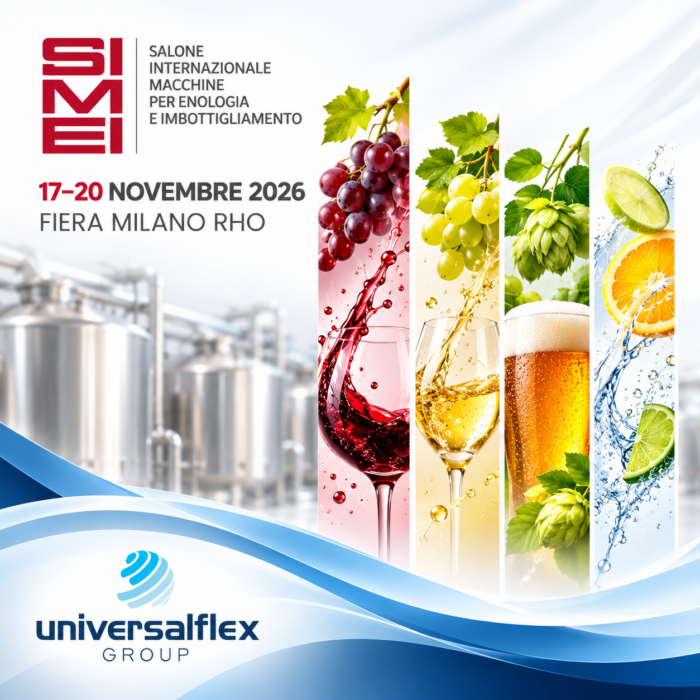
From November 17 to 20, 2026, Fiera Milano Rho will host the 31st edition of...
Anyone who works in a dairy, winery, or beverage plant...
From October 27 to 30, 2026, Fiere di Parma will host Cibus Tec, the...
PTFE (polytetrafluoroethylene) is the leading fluoropolymer for industrial seals...

🚀 We're ready for Cibus Tec 2026! From October 27th to 30th, we'll be there...
Adding {{itemName}} to cart
Added {{itemName}} to cart


